I'm back. Sort of.
My friends know I'm not particularly techy. I have, thus far, managed to maintain a blog, an Etsy shop, and a presence on Facebook and Patternreview with dial-up internet service.
Yes. Dial-up.
Know why? It works for me. I spend all day at work on a computer, barely moving from my chair unless it's to chase down a lawyer. When I get home, I still want to do things online, but I don't want to spend my entire evening in another desk chair. Thus, dial-up. If it takes some time to load something, fine. I'll go sew a seam, or throw in a load of laundry or spend some time talking to Mario while he watches TV. The speed, or lack thereof, has never bothered me and it's actually caused me to get a lot more accomplished while waiting for it to accomplish something.
But now, with Blogger's new, evil interface, Google Chrome has entered my life. It's entered my computer, somewhat unwillingly, and it's wearing my dial-up connection like a too-tight shirt.
I fear that higher speeds may be in my future. But that's okay, I'll just let it do it's zippy, unnecessary thing and I'll still wander off and do other things.
The illustrations here have nothing to do with my technological mutterings. Tuesday was Mario's 40th birthday, and all special occasions warrant a new shirt. He picked this fabric out last year, it's a William Morris print that I ordered from eQuilter, and despite the fact that it's intended as a quilting fabric, it's actually a very nice lawn. It's not Liberty, but it's close. He refused to justify the cost of Liberty for a shirt.
The colors are much more the detail photo at left, but for some reason I couldn't get them to come up properly on the distance shot; it's really not a pink shirt.
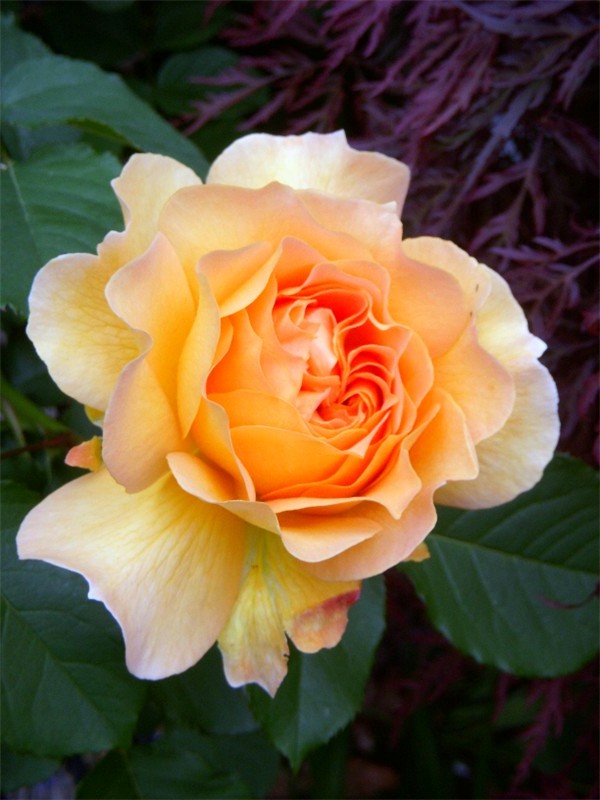
And because this post doesn't have enough flowers, a gratuitous photo from my front garden, where all the roses have decided to bloom at once. This is a particular favorite. I don't remember the name, but it starts out this gorgeous golden-apricot, and by the time it's full blown, it's a pale honey-ivory shade.
So I guess I'm back. Right now Chrome is grudgingly working, but I've been promised a bandwith upgrade thing by the weekend, and apparently then my life will change, the sun will rise brighter in the morning, angels will sing and my computer will move at something faster than the speed of mud.
Technology. Humbug, I say.
Monday, April 30, 2012
Saturday, April 28, 2012
Unplanned Blogging Break
I hate Blogger's new interface. Hate-hate-hatey-hate it. It's disagreeing with my computer, and it isn't even supported by the browser at work.
Will be back with goodies as soon as technology cooperates. Which should be by end of weekend.
Happy sewing, all. That's what I'm doing, since I'm not online!
Will be back with goodies as soon as technology cooperates. Which should be by end of weekend.
Happy sewing, all. That's what I'm doing, since I'm not online!
Sunday, April 22, 2012
Journey to a Skirt
A while back I had an idea for a skirt. I'm not
quite sure where it came from, but it was a gray skirt, and the bottom of the
skirt was pieced fabrics in grays, silver and black, possibly lightly quilted.
The piecing was random, square, rectangular, wide, tall. I had a vague idea
that it might look like a skyline, so in my head I was calling it the Cityscape
Skirt.
Fast forward to Tuesday night. Mario has a class that night and I spend the 3 hours of his absence sewing like a demon. I made a pair of my favorite TNT pants on Tuesday from some lovely charcoal gray RPL that I got from Gorgeous Fabrics a while back. Before I started cutting, I realized that if I played my cards right and cut very, very carefully, I would have enough left over to make a pencil skirt. I already knew I had the other fabrics in either stash or remnants.
The pants were finished and I was hemming them by the time he got home. I'd also cut out the pencil skirt and had a small chunk of fabric left over besides. Amazing what careful cutting can do.
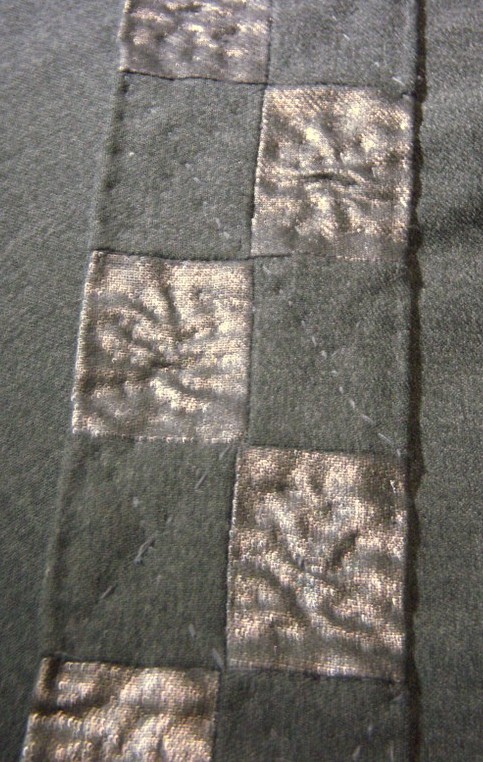
The next night, I cut out a bunch of pieces of black, light gray, silver (a metallic coated cotton) and self fabric and played with layout. I could see my original idea in my head, but I couldn't make it come together on the table. Everything looked forced and weird. Eventually I cut a long strip of the silver coated cotton and the self fabric, sewed them together and cut them in 2" sections. Those were sewn together in an alternating checkerboard, and I laid it across the bottom of the skirt to see how it looked.
Hmm. I couldn't quite tell from there, so I decided just to go with it. I sewed the patchwork band on the skirt from the underside at the top, then folded and pressed the hem of the skirt and the band. I had some quilt batting on hand that I didn't use for the 1912 jacket, so I cut a strip of that and put under the band. I hand-sewed the hem, then topstitched the top of the band. It looked raised, but not puffy. I was encouraged. I did a line of stitching down the center of the strip, then started playing around with it. I sewed X's through each of the gray squares, and then did spirals in the silver squares, pulling the thread tightly to add texture to the silver. From a distance it looks somewhat like leather.
I'm still not sure where I'm going here, but it's an interesting journey all the same.
Fast forward to Tuesday night. Mario has a class that night and I spend the 3 hours of his absence sewing like a demon. I made a pair of my favorite TNT pants on Tuesday from some lovely charcoal gray RPL that I got from Gorgeous Fabrics a while back. Before I started cutting, I realized that if I played my cards right and cut very, very carefully, I would have enough left over to make a pencil skirt. I already knew I had the other fabrics in either stash or remnants.
The pants were finished and I was hemming them by the time he got home. I'd also cut out the pencil skirt and had a small chunk of fabric left over besides. Amazing what careful cutting can do.
The next night, I cut out a bunch of pieces of black, light gray, silver (a metallic coated cotton) and self fabric and played with layout. I could see my original idea in my head, but I couldn't make it come together on the table. Everything looked forced and weird. Eventually I cut a long strip of the silver coated cotton and the self fabric, sewed them together and cut them in 2" sections. Those were sewn together in an alternating checkerboard, and I laid it across the bottom of the skirt to see how it looked.
Hmm. I couldn't quite tell from there, so I decided just to go with it. I sewed the patchwork band on the skirt from the underside at the top, then folded and pressed the hem of the skirt and the band. I had some quilt batting on hand that I didn't use for the 1912 jacket, so I cut a strip of that and put under the band. I hand-sewed the hem, then topstitched the top of the band. It looked raised, but not puffy. I was encouraged. I did a line of stitching down the center of the strip, then started playing around with it. I sewed X's through each of the gray squares, and then did spirals in the silver squares, pulling the thread tightly to add texture to the silver. From a distance it looks somewhat like leather.
I'm still not sure where I'm going here, but it's an interesting journey all the same.
Tuesday, April 17, 2012
And the winner is . . .
Lily the Sewing Room Cat has spoken.
And no one, but no one - especially me - argues with Lily. She's tiny but mighty. And somewhat cranky. And if I argue with her, she'll eat scraps and thread and return them to me in an unpleasant form some time when I'm not prepared to step on them.
And she chose Beverly of Sew Much More to be the winner of my copy of I Spy DIY Style.
Beverly, please contact me with your mailing address and I'll send the book on to you.
And no one, but no one - especially me - argues with Lily. She's tiny but mighty. And somewhat cranky. And if I argue with her, she'll eat scraps and thread and return them to me in an unpleasant form some time when I'm not prepared to step on them.
And she chose Beverly of Sew Much More to be the winner of my copy of I Spy DIY Style.
Beverly, please contact me with your mailing address and I'll send the book on to you.
Monday, April 16, 2012
The Afghan Farmer's Daughter
Sorry for the cryptic title; it's in honor of Kashi at Metro Textiles, who after he tried to tell me that these weren't poppies all over the fabric (I think poppies have some kind of negative drug connotations to him), then acknowledged they were and told me -- and I don't know if this is true, but it made for a good fabric story -- that Afghan poppy farmers receive their money from the drug lords before planting season, and then hope for the best. When the crop is harvested, if he doesn't have enough to pay back his advance money, he has to hand over one of his daughters.
I said that was horrible, and Kashi just spread his hands. "They have a lot of daughters," he said, "but it's not good."
This has nothing at all to do with my fabric other than this story is going to be permanently stuck in my head whenever I wear this dress, so I've named it in honor of all those Afghan farmers' daughters, who, even if they were allowed to stay with dear old dad on the poppy farm, would never get to wear this dress.
The patternreview is here. I love this dress way more than I expected to - I've had this pattern (V8633) since it came out, and wondered a few times since why I bought it. At the time I remember liking the version with the straight skirt; when I started on it this time, it was the big skirt all the way.
Apparently some patterns, like fabrics, need to marinate in stash for a while until they're ready.
I took my time on this one. There's quite a bit of hand sewing inside the bodice, and because it's a circle skirt, I hemmed it by hand so I would have more control of the curve. I don't know as I needed to do that much, but after working on the 1912 Project patterns for a while, I'm beginning to appreciate the meditative aspect of some hand sewing.
Which is good, because the hem is the only meditative thing about this dress. I think the loudness of my dress was the only thing keeping me awake this morning after my non-drowsy allergy meds kicked in.
I said that was horrible, and Kashi just spread his hands. "They have a lot of daughters," he said, "but it's not good."
This has nothing at all to do with my fabric other than this story is going to be permanently stuck in my head whenever I wear this dress, so I've named it in honor of all those Afghan farmers' daughters, who, even if they were allowed to stay with dear old dad on the poppy farm, would never get to wear this dress.
The patternreview is here. I love this dress way more than I expected to - I've had this pattern (V8633) since it came out, and wondered a few times since why I bought it. At the time I remember liking the version with the straight skirt; when I started on it this time, it was the big skirt all the way.
Apparently some patterns, like fabrics, need to marinate in stash for a while until they're ready.
I took my time on this one. There's quite a bit of hand sewing inside the bodice, and because it's a circle skirt, I hemmed it by hand so I would have more control of the curve. I don't know as I needed to do that much, but after working on the 1912 Project patterns for a while, I'm beginning to appreciate the meditative aspect of some hand sewing.
Which is good, because the hem is the only meditative thing about this dress. I think the loudness of my dress was the only thing keeping me awake this morning after my non-drowsy allergy meds kicked in.
Sunday, April 15, 2012
VPLL E0189 - Ladies Spring Mantle - Finished
Just in time for the 100th anniversary of the sinking of the Titanic, I've finished my third garment in the 1912 Project, the Ladies' Spring Mantle. The official patternreview is here; the review below is using a template supplied by the VPLL project to give them information they need in cataloging the work we've done and the work that may need to be done with these patterns.
1. Pattern Name: E0189 Ladies' Spring Mantle
2. Sewer's Skill Level: Advanced.
3. Pattern Rating and why: 5 - I LOVED IT! It totally lived up to the pattern drawing. Not only is it a beautiful jacket of its period, it's just as beautiful 100 years later. I fully intend on wearing this as part of my day-to-day wardrobe, not as a period piece.

4. What skill level would someone need to sew this pattern and why? This is another pattern that looks more complicated than it is. While it might not be for beginners, I think an intermediate sewist with patience would have no problem making this at all. Patience simply because these patterns expect a certain level of knowledge; there's no spoon-feeding here. And while nothing in this pattern was particularly complex, like other VPLL patterns in the 1912 Project, there are fiddly bits (i.e., the trim) that take a lot of time.
5. Were the instructions easy to follow? If not, what needs to be changed? The instructions were minimal (by today's standards), but clear. One issue I had with the instructions was regarding the underarm gusset - the instructions said to follow the marked stitching line on the gusset, rather than using the seam allowance, and I just couldn't make that work no matter how I tried. When I did what I instinctively thought was right, using the seam allowance, it worked and fit fine. So there's something amiss there, unless it was just me.
6. How was the fit/sizing? Did it correspond to what you thought? The pattern was sized for a 36 bust, and since that's what I generally require, I was hoping for an accurate fit. I actually cheated and didn't make a muslin for this jacket, I was so hoping that it would fit. Hubris isn't always rewarded, so I'd better watch it next time I think I'm safe.
7. Did you make any pattern alterations? If so, what alterations did you make? Were they fit or design alterations? My changes were to the order of construction - rather than constructing and trimming the shell, then constructing the lining and sewing the two together, I constructed the shell and lining and bagged them together as I would a modern jacket, leaving a small opening at the hem to turn the jacket right side out. I then made all the trim and hand sewed it on.
8. Changes I'd like in this pattern: None whatsoever. This worked out beautifully for me and I intend on making another very soon.
9. Changes to instructions: I think some clarification regarding the gusset would be helpful. Also, for those who aren't accustomed to older techniques, maybe providing modern alternatives would be helpful (as in bagging the jacket lining). Though personally I like the challenge of figuring it out on my own, but I've been told before that I'm a little strange.
10. Discussion of fabric/trim, etc. I used very historically inaccurate polyesters all the way. The shell fabric feels a bit like taffeta, with a crinkled texture and embroidery/sequins. The lining is copper poly charmeuse. The two fabrics work well together, but I think I could have gotten a better texture on the shirred trim if I had used silk charmeuse; even cut on the bias, the poly is just a little too bouncy.
11. Description of technique - insertion, cutwork, etc. The only unusual technique in this garment is the trim, which is a 10 yard long bias strip (I used the charmeuse lining fabric), sewn together, turned and pressed flat. The instructions offer an option of threading strips of quilt batting into the tube before it is gathered, but I found the batting to be too thick when added to the already substantial fabric. Maybe 1912 batting had a better texture? Stuffed or unstuffed, the bias tube is then gathered on both sides and pinned or basted around the edge of the jacket and sleeves. To gather the trim, I used my machine's basting stitch, in 2 foot long increments. As I gathered each section, I pinned it to the jacket and then I hand sewed it to the jacket. I did the same for the sleeves.
1. Pattern Name: E0189 Ladies' Spring Mantle
2. Sewer's Skill Level: Advanced.
3. Pattern Rating and why: 5 - I LOVED IT! It totally lived up to the pattern drawing. Not only is it a beautiful jacket of its period, it's just as beautiful 100 years later. I fully intend on wearing this as part of my day-to-day wardrobe, not as a period piece.
4. What skill level would someone need to sew this pattern and why? This is another pattern that looks more complicated than it is. While it might not be for beginners, I think an intermediate sewist with patience would have no problem making this at all. Patience simply because these patterns expect a certain level of knowledge; there's no spoon-feeding here. And while nothing in this pattern was particularly complex, like other VPLL patterns in the 1912 Project, there are fiddly bits (i.e., the trim) that take a lot of time.
5. Were the instructions easy to follow? If not, what needs to be changed? The instructions were minimal (by today's standards), but clear. One issue I had with the instructions was regarding the underarm gusset - the instructions said to follow the marked stitching line on the gusset, rather than using the seam allowance, and I just couldn't make that work no matter how I tried. When I did what I instinctively thought was right, using the seam allowance, it worked and fit fine. So there's something amiss there, unless it was just me.
6. How was the fit/sizing? Did it correspond to what you thought? The pattern was sized for a 36 bust, and since that's what I generally require, I was hoping for an accurate fit. I actually cheated and didn't make a muslin for this jacket, I was so hoping that it would fit. Hubris isn't always rewarded, so I'd better watch it next time I think I'm safe.
7. Did you make any pattern alterations? If so, what alterations did you make? Were they fit or design alterations? My changes were to the order of construction - rather than constructing and trimming the shell, then constructing the lining and sewing the two together, I constructed the shell and lining and bagged them together as I would a modern jacket, leaving a small opening at the hem to turn the jacket right side out. I then made all the trim and hand sewed it on.
8. Changes I'd like in this pattern: None whatsoever. This worked out beautifully for me and I intend on making another very soon.
9. Changes to instructions: I think some clarification regarding the gusset would be helpful. Also, for those who aren't accustomed to older techniques, maybe providing modern alternatives would be helpful (as in bagging the jacket lining). Though personally I like the challenge of figuring it out on my own, but I've been told before that I'm a little strange.
10. Discussion of fabric/trim, etc. I used very historically inaccurate polyesters all the way. The shell fabric feels a bit like taffeta, with a crinkled texture and embroidery/sequins. The lining is copper poly charmeuse. The two fabrics work well together, but I think I could have gotten a better texture on the shirred trim if I had used silk charmeuse; even cut on the bias, the poly is just a little too bouncy.
11. Description of technique - insertion, cutwork, etc. The only unusual technique in this garment is the trim, which is a 10 yard long bias strip (I used the charmeuse lining fabric), sewn together, turned and pressed flat. The instructions offer an option of threading strips of quilt batting into the tube before it is gathered, but I found the batting to be too thick when added to the already substantial fabric. Maybe 1912 batting had a better texture? Stuffed or unstuffed, the bias tube is then gathered on both sides and pinned or basted around the edge of the jacket and sleeves. To gather the trim, I used my machine's basting stitch, in 2 foot long increments. As I gathered each section, I pinned it to the jacket and then I hand sewed it to the jacket. I did the same for the sleeves.
Friday, April 13, 2012
Pick One
| E0335 |
Hmmm. That didn't sound good, did it?
The Titanic project is getting under way. (Better; it doesn't sound like looming icebergs this way).
There are many more patterns available, and the rules have changed so that there's more freedom in requesting patterns - we don't have to wait for specific assigned patterns. I'm thinking I may need to make another blouse, one for me this time, since I really enjoyed making the last one but didn't get to keep it.
Here are the patterns I have to choose from at this point. The descriptions are from VPLL's website, and the colors/fabrics basically describe the source garment, not how I would have to make it up.
| E1000 |
2. E1000 - This beautiful ladies blouse features a pleated front with cutwork scallops and padded granitos at collar, cuffs and basque.
3. E0219 - This blouse without a lining is made of checked fabric in blue, green and white. The detachable collar is made of stiff white linen.
| E0219 |
The second blouse is probably the least likely to be worn, but the part of me that loves repetitive idiot work (I find it soothing) is intrigued by the cutwork scallops and whatever the heck a "granito" is.
The last one, well, that looks like fun, doesn't it? Not the strangulating high collar, maybe, but the bias plaid and the interesting curved seam at the shoulder (and no visible armscye/sleeve seam) strike me as something I'd enjoy playing with. Plus this one has a front closure, so I could actually dress myself.
Which blouse do you think I should tackle for May? (1) E0335 - pleats with lace; (2) E1000 - pleats, cutwork scallops and "granitos"; or (3) E0219 - plaid, pleats and interesting seaming.
I'd love to hear your thoughts on this one.
Subscribe to:
Posts (Atom)