Showing posts with label tudors. Show all posts

Wednesday, August 28, 2024

Moving along

Things are moving along this week. I'm not quite keeping up with them. 

My husband started a new job on Monday after being laid off back in February. Severance package was good so no worries there but it's good to get back to normal. 

Tomatoes are still threatening to take over the house. I'm watching a neighbor's cat in the afternoon so I took a big batch to her house to process in her (larger, air-conditioned) kitchen. 

Work is going well on the next book, and I just finalized a set of new covers for the Tudor books with the designer. A proper reveal is coming soon. 

Speaking of Tudors, I found this lithograph of Henry VIII and Anne Boleyn recently on eBay. I'd first seen it years ago and lost the auction at the very end, but this had a solid 'buy it now' price and so I did. Once I find an appropriate frame, it'll go up in the bedroom with the rest of the family. 

I'll check the basement. There's a very good chance the perfect frame already exists and is just covered in dust.

Wednesday, March 27, 2024

Anyone have a bridge for sale?

The Son in Shadow, Tudor book 4, is almost there. Almost done. I'm very glad I shifted from my original planned mid-April release date, because while I could get it done and edited and formatted in time, I would be a rag, and April is also the start of craft show season, so I'd prefer not to do that to myself.

I really thought it would go faster, though. It's the fourth book in a series. I know the main character - he's been in my head and in my books since A Wider World. There are also appearances by Bess and Tom from Songbird; Robin and Margaery from A Wider World and Lady, in Waiting, and a few other returning characters. I know all of them, and sections of this book have been drafted since before I started working on the Ava & Claire series.

Okay, so the later middle Elizabethan reign - 1568 - 1571 - was some new ground for me to explore, but I didn't think it would take this long for me to get my thoughts together. I'm about 20%, maybe less, from the end and I just keep walking around it and looking at it and trying to figure out where I'm going. I know the end, but it's like I'm across the river from it and no bridges are magically appearing.

Anybody got a bridge they'd like to sell me?

Wednesday, June 14, 2023

A Tudor Discovery!


History lovers around the world have been geeking out for the past week over a new discovery - a book of hours not only owned by Thomas Cromwell, but memorialized in Hans Holbein's portrait of him.

This comes on the heels of the discovery of letters penned by Mary Queen of Scots last year, and the discovery - by some of the same historians - that Henry's first two queens, Catherine of Aragon and Anne Boleyn, each had a copy of the same prayer book, printed and bound in France in the late 1520s.

The three books are similar but still very individual, showing just how much hand finishing went into a book in the 16th century. Cromwell's is the only one to retain its original jeweled binding and clasps.

Cromwell's book was located a library at Cambridge University, donated in the 1660s by a relative of Ralph Sadler. Sadler was a member of Cromwell's household since his childhood, and survived his master's fall to serve the king. (What must that have been like?)

I spent a lot of time researching Thomas Cromwell for my novel, a wider world, even though he only made brief appearances. He was, however, the architect of the dissolution of the monasteries, and that event change the course of my main character's life, as Robin Lewis had been raised in a monastery and then returned as one of Cromwell's men. His self-appointed task was to rescue books, so I think he would be happy to know that this book of hours is still in existence.

A man like Cromwell, constantly treading dangerous ground with Henry and the factions aligned against him, must have had a plan for an event such as his arrest. I can only imagine when the news raced back to his house, knowing there was nothing they could do to sway the king's actions, how his household gathered his books and papers and got them safely away where they could not be used to incriminate their employer. How many of them were destroyed on Cromwell's death? How many of them ended up in the libraries of great houses, or great universities, yet to be discovered? 

This is why I love history. It's still happening.

Links to posts by Owen Emmerson Cromwell book) and Kate McCaffrey (queens' books) because they were the ones who made the discoveries, and can speak much more clearly about it than I can. Also a link to the entire digitized book, via the library.
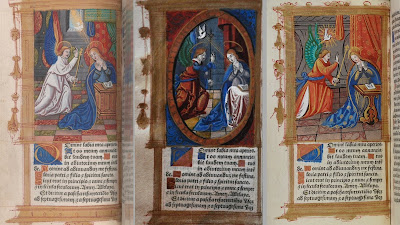
Annunciation page from all 3 books.
L - Catherine of Aragon, M - Anne Boleyn, R - Thomas Cromwell

https://drowenemmerson.com/thomas-cromwell-discovery/

https://kateemccaffrey.wordpress.com/blog/

https://mss-cat.trin.cam.ac.uk/manuscripts/uv/view.php?n=C.30.9&fbclid=IwAR2zEdQtgAf_m7A3AlDQ8ALvfLyts1qLnJr2H5jKFP7WGYdyvxXW3YxKsRM#?c=0&m=0&s=0&cv=0&xywh=-1%2C-4467%2C3800%2C13525

Wednesday, April 12, 2023

A night out


We had a night out this past week - Six was playing at Philadelphia at the Academy of Music and we treated ourselves to tickets. They weren't "Broadway" expensive, which is always good for the budget, but they were worth every cent. And the Academy is one of my favorite venues and will appear in the third of my 1930s books, so I looked around and took notes while I was there. 

I wasn't sure how I'd feel about it, actually - since I've been steeped in Tudor history since I was a kid - but I enjoyed every bit of it. Like Hamilton, it's bound to get new people interested in that period of history, and also like Hamilton, it's full of catchy songs that I'm still humming a few days later.

From the first note, the lights and costumes and sheer energy of the show made me smile. I wasn't sure about my husband - he's very tolerant and actually well-versed in Tudor history these days - but going by the audience, this was going to be an absolute estrogen-fest. Groups of girlfriends, mothers and daughters, much squealing and shrieking.

It was fabulous. (And husband survived quite nicely).

It does make me wonder how the wives would feel about being remembered in such a way. Honored? Annoyed? Confused, definitely. They might not understand what a musical was, they definitely wouldn't understand this musical as "music" as it was defined in their day, and they might be offended at some of the portrayals (though they were definitely based on well-known facts, just well-known facts might not be quite factual for some of these ladies).

But still.. almost five hundred years later, they're remembered. And as one of the key questions goes near the end of the show, are they remembered simply because they shared a husband? Or is their husband remembered because of them?


Sunday, November 6, 2022

Alternate Endings: Samantha Wilcoxson and Reginald Pole

Yesterday I talked about Princess of Spain, my story in the Alternate Endings anthology.

Today I have as my guest Samantha Wilcoxson, whose story, Tudors with a Twist, imagines alternate endings for both Mary and Elizabeth Tudor.

I'll let Samantha tell you more:

Reginald Pole, King of England?

 When I began writing, I was obsessed with the Wars of the Roses – all the drama, betrayals, and what-might-have-beens. It was such a tragic time in history with plenty of unknowns to keep a historical novelist busy. I hadn’t planned to write a series, but I ended up expanding into the early Tudor era, where the historical figures that intrigued me most weren’t the popular ones. Plenty of people wrote about Anne Boleyn and Henry VIII. I was more interested in Margaret Pole’s family and the often overlooked and misunderstood Queen Mary.

As I dug into this part of Tudor history, I kept coming back to one person, who seemed like they really tried to make a difference, and I naturally wondered if he could have done more. Reginald Pole was one of Margaret Pole’s sons. She was the daughter of George of Clarence, who had been executed by his brother, Edward IV. In other words, Reginald had more than a few drops of royal blood running through his veins, enough that his older brother, Henry Pole Baron Montagu, had been executed as part of the supposed Exeter Conspiracy.

Reginald had been in Europe while most of this was going on. Henry VIII sponsored Reginald’s education early on before the king’s lack of sons made him jealous and paranoid about his cousins. From this safe distance, Reginald, a cardinal of the Catholic church in 1536, spoke out against the actions of Henry VIII and attempted to convince the monarch to repent of his sins and reunite his kingdom with Rome. Since Henry Tudor was known for his calm demeanor and willingness to accept rebuke, this all went over really well….

Henry was furious that Reginald did not support his separation from Katharine of Aragon, marriage to Anne Boleyn, and split from Rome after all that Henry had done to raise up Reginald and the rest of the Pole family. After executing Henry Pole, whose son also mysteriously never left the Tower of London, the king sent assassins to Europe to deal with Reginald. Thankfully, they were unsuccessful, and I would not have wanted to be them admitting their failure before Henry VIII!

Here is where my Alternate Ending comes into play. When Princess Mary and Reginald were much younger, their mothers had been great friends. Margaret Pole even served as Mary’s governess until Henry sent both Katherine and Margaret away. These friends thought a match between their children would be ideal and would be one more link healing the divisions caused by the Wars of the Roses. They had a common ancestor in Richard Duke of York and, if no sons came, Englishmen might accept Mary as queen with a nobleman like Reginald at her side.


This plan came to nothing as the king refused to make marriage arrangements for Mary or consider her his heir. Then he did have a son, so it didn’t seem to matter. Until Edward VI died and Mary claimed her crown.

In reality, Mary chose to wed Philip of Spain. He was untrusted by her English subjects and did not treat her well. Protests against Spanish rule melded with those opposed to the burning of protestants, stirring up a well of rebellion among a people who had recently declared Mary their chosen queen.

I couldn’t help but ask myself how much better things might have gone if Mary had selected Reginald instead. In Europe, Reginald had attempted to find common ground between Catholics and reformers, and he was even almost elected pope in 1550. Might he have made a more acceptable king?

Instead, he did return to England, where he served as Mary’s Archbishop of Canterbury – the last Catholic to hold that position. He served as a spiritual advisor, but I have to wonder if he wouldn’t have made a better husband. I mean, it would have been difficult to have been a worse husband than Philip of Spain!

Mary probably still would have struggled with infertility. Elizabeth probably would have still inherited the throne. And Mary and Reginald would have still died on the same day, 17 November 1558. But what else might have changed if Reginald Pole had served as King of England?

Read my story in Alternate Endings to find out!

Blog

https://samanthawilcoxson.blogspot.com/

Twitter

https://twitter.com/carpe_librum

Instagram

https://www.instagram.com/samantha_wilcoxson

Facebook

https://www.facebook.com/PlantagenetEmbers/

Goodreads

https://www.goodreads.com/samanthajw

Pinterest

https://www.pinterest.com/samantha_wilcoxson/

Amazon Author Page

https://www.amazon.com/author/samanthawilcoxson


Saturday, November 5, 2022

Alternate Endings: The Inspiration Behind Princess of Spain

So my submission for the Alternate Endings anthology is called Princess of Spain, and in my mind, it rights a certain number of historical wrongs.

What if Arthur Tudor hadn't died? What if he'd stayed married to Catherine of Aragon, consummated that marriage, had children? What if - because he was a different man than his brother - the war in Scotland had ended differently, and he stayed on good footing with his sister Margaret's husband, instead of leaving her a widow? What if there hadn't been a war with France? What if Thomas Wolsey's role had remained as priest and advisor, instead of being promoted to chancellor and cardinal and all-around-fixer?

What if Henry Tudor stayed in the place that history had intended for him - as Arthur's younger brother, bound for the church. Archbishop of Canterbury or York, maybe someday a cardinal's hat. A good place for an ambitious man, but not as good as the role history gave him when Arthur died of what was probably the sweating sickness.

When Henry became king, he married his brother's widow (touting that unconsummated marriage), warred with Scotland (his brother-in-law, the Scottish king, killed in the process), warred with France (expensive and not tremendously successful, though battles were won), but failed to have a living son with his queen, leading to five more wives, the break with Rome, the dissolution of the monasteries, and the execution of many people (good and bad).

I wanted to explore what might have happened if Arthur, the brother who had been brought up to be a monarch, actually had the chance to live out the history intended for him. It also gave me the chance to rehabilitate a few people (in addition to Catherine) whose lives might have been very different if there had been a King Arthur.

And okay, I also wanted Henry to get a little of what he deserved, but what lover of Tudor history doesn't want to see Henry get what he deserved, really?

Alternate Endings is available here - not only will you get Princess of Spain, but seven other stories, including another one set during the Tudor era. 

Wednesday, July 6, 2022

A little something extra

Well, this was unexpected. 

Lady, in Waiting, the third book in my Tudor Court series, came out in February. While I do intend to go back to this series at some point - after I finish with the 1930s - three books are sufficient to make an omnibus collection, and that's what I'm currently working on.

It was on my eventual list of things to do, but one of the writing groups I belong to on Facebook made the point that the readers who buy box sets are different from the readers who buy one book at a time. They're also often the bargain shoppers - three books for the price of two? They're on it.

So that's what I've been up to over the long weekend - compiling all three manuscripts into one, swearing a blue streak at Word (and myself) because the styles for the three books don't match and I had to remove all the formatting and put it back to get the table of contents to work. You wouldn't think I'd been a legal secretary for 30 years, turning Word inside out and making it do my bidding. I've never been a fan of styles, and I'm still not, but I am a fan of only having to format my ebooks once, so this work will be worth it in the end.

And before the end of July, The Tudor Court - The Complete First Trilogy, will be available for purchase.

And I will be a small puddle on the floor, scrabbling to reach the keyboard to get back to work.

Thursday, September 3, 2020

Progress on Book 3

Should I be talking about book 3? When book 2 won't be released until April?

Maybe not, but I am, because I've hit a really interesting part of the process. I'm working on the first draft, currently titled Lady, in Waiting (crucial comma). Like Robin in A Wider World, Margaery, my main character, was a secondary character in AWW who required her own story.

She's 24, English but raised in France, and newly married to a man she barely knows. It was a self-arranged marriage, because she met him and thought he was a far better option than the men put forward by her mother and stepfather. But it's still an odd situation - they're two very nice people, neither of whom had planned to marry, and they're learning as they go. To complicate things, they both work in the Tudor court: Margaery as a minor lady in waiting to Elizabeth I, and her husband as an assistant to William Cecil, the queen's chief secretary.

Technically that means they have the same boss and the same loyalties, but in fact, it does not. Elizabeth's women swore an oath of loyalty to the queen, and while Cecil and his men are also loyal to the queen, they're working on behalf of the government, and their aims might be somewhat different than Elizabeth's.

What went on in the queen's chambers stayed in the queen's chambers. Which makes evening conversation with a husband somewhat limited.

I've been working on this story for a while, but it's only in the last few days that Margaery has really come to life and started acting independently, choosing courses of action I wouldn't have thought of and saying the occasional unexpected thing.

It's my favorite part of writing, even though it means I'm going to have to go back and edit her earlier words to reflect this more fully developed personality. When my people make me swear at them because they don't behave, I know I'm getting somewhere.

Monday, January 6, 2020

The One That Got Away

On this day, January 6, 1540, Henry VIII married his fourth sife, Anne of Cleves. Despite the beauty of Holbein's portrait, Henry (a real picture himself) did not like his new wife.

Anne agreed to an annullment and assumed the title of the "King's Dear Sister," which got her property, a pension, and most importantly, continued possession of her head.

She is one of my favorites of Henry's queens, simply because of her common sense. She looked at his track record, she looked at her own position, and she very intelligently decided that her life would be best served - and best continued - by giving him what he wanted.

The marriage to Anne of Cleves also ended the life of the King's Lord Chancellor, Thomas Cromwell, a man who had survived all the ups and downs of the reign thus far. Henry used the marriage as an excuse, but I'm sure there was more to it. He also regretted the execution almost immediately, and it serves him right. Cromwell was no saint, but for the most part, he was just doing his master's bidding.


Thursday, November 14, 2019

The more you know

Did you know there were black Tudors? Not the royal family, but people living in England during that period? 

I wasn't aware, and this video, from historian Miranda Kaufman, is very interesting. Some of what I learned here may be included in my next book, if the right character finds me.

I've seen black characters in some recent historical productions (The Spanish Princess comes to mind), but I think these have been taken a little far - while Katherine of Aragon may well have brought black servants with her from Spain, it's very unlikely that one would have been her lady-in-waiting. That wouldn't have been a race issue, but the fact that ladies-in-waiting were generally high-born young women, maneuvered into those positions by their families to get them close to power, powerful men, and advantageous marriages. 

On the other hand, as noted in this video, Henry VII (big Henry's dad) did have a black trumpeter named John Blanke, so while there weren't likely black courtiers, there were black people at court.

This is one of the things I love about history - you keep finding out new and interesting bits that you hadn't expected, and they keep leading you deeper and deeper.